
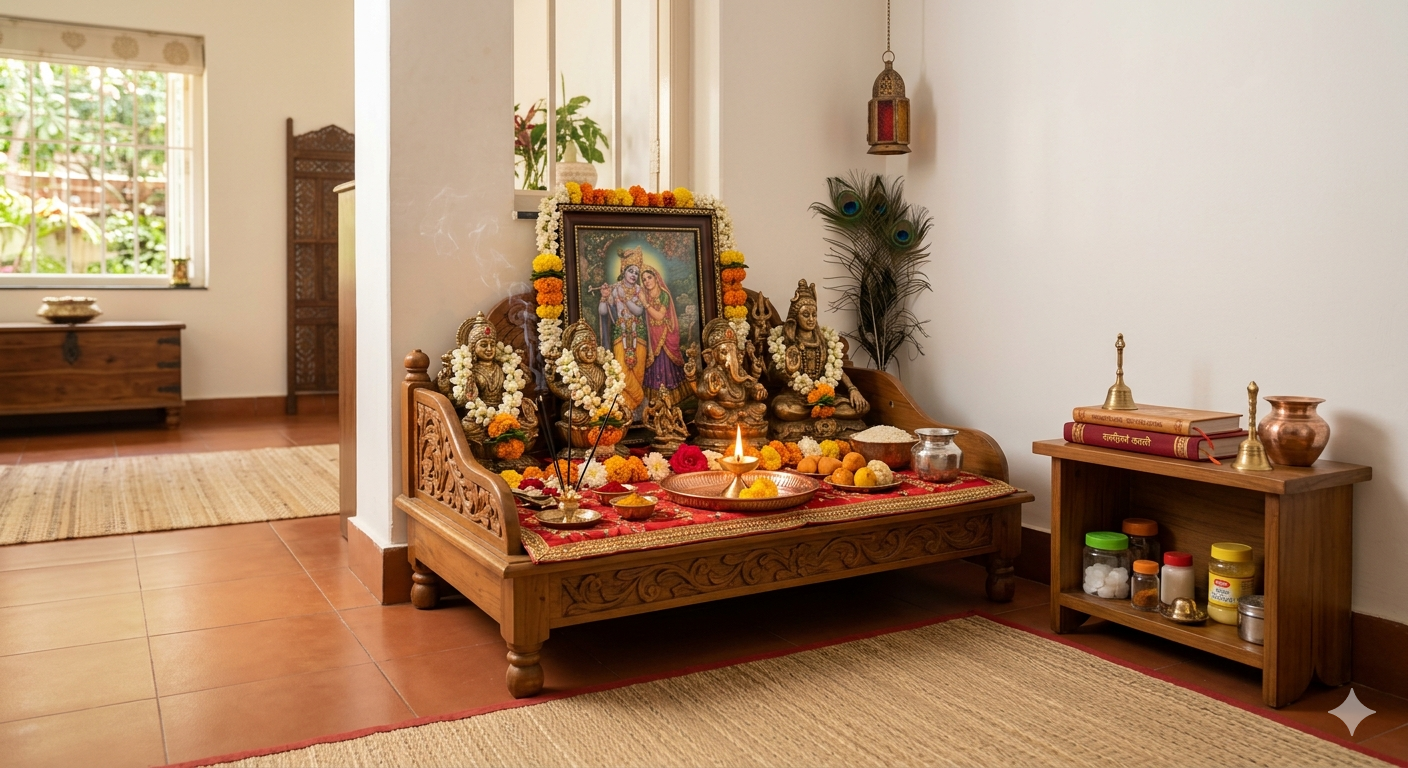
The pooja room gets squeezed into whatever corner is left. The mandir goes wherever it fits. Idols accumulate. The diya burns every morning, but the space never quite feels right — and nobody can say why.
Vastu Shastra — the ancient Indian science of space and direction — has clear guidelines around where and how a pooja room should be set up. Ignore them, and the energy of the space can feel heavy, distracted, or simply off. Follow them, and the room becomes what it’s meant to be: a still, centred space for prayer and reflection.
Here are seven Vastu mistakes that are surprisingly common — and how to correct them.
Mistake 1: Wrong Placement of the Pooja Room
The direction of your pooja room matters more than most people realise.
Vastu For Pooja Room, the north-east corner of the home (called Ishan Kona) is the most auspicious placement. This corner receives the most positive cosmic energy and is considered the zone of water and spirituality. The east direction is the second-best option, as it faces the rising sun.
Placing the mandir in the south or south-west is a common mistake. These directions carry heavy, earthly energy — not ideal for a sacred space. Similarly, placing it directly above or below a toilet, bathroom, or staircase creates an energetic conflict that Vastu considers deeply inauspicious.
If moving the entire room isn’t possible, use the north-east corner of an existing room for your mandir.
Mistake 2: Keeping the Pooja Room Inside the Bedroom
This is one of the most debated topics in pooja room Vastu — and one of the most misunderstood.
Technically allowed. Practically a bad idea.
The bedroom is a space of rest, intimacy, and sleep — all of which pull against the energy of a sacred prayer space. The deity is present in the mandir. Keeping them in a space associated with bodily rest — especially if you sleep with your feet pointed toward the mandir — is considered disrespectful and energetically disturbing.
If your mandir must stay in the bedroom, use a wooden cabinet with doors that can be closed at night and during intimate moments.
Mistake 3: Placing Broken or Damaged Idols
A cracked, chipped, or broken idol in the pooja room is one of the clearest Vastu mistakes you can make. According to traditional Vastu and Agama Shastra, a damaged murti should not be worshipped.
A broken idol cannot hold or transmit positive divine energy. Keeping it in the mandir weakens the spiritual energy of the space and draws instability into the household.
Damaged idols should be respectfully immersed in a flowing water body — river or sea. Replace them with new, intact murtis.
Mistake 4: Too Many Idols in the Mandir
More is not always better — especially in a prayer room.
The Brihat Samhita is clear: no more than two or three of the same deity. An overcrowded mandir creates visual and energetic clutter, makes cleaning and daily rituals difficult, and the space quietly deteriorates.
Keep only the principal deities your family worships. Photographs can add to idols but should not crowd the space.
Mistake 5: Ignoring the Height of Idol Placement
Where the idols sit within the mandir matters in Vastu.
Idols should be placed at eye level or slightly below — not at floor level and not so high that the worshipper has to crane their neck. The feet of the idol should not touch the back wall of the mandir.
There should also be a gap of at least an inch between the idol and the mandir wall. This allows energy to circulate and keeps the sacred space from feeling hemmed in.
Use a platform or pedestal (peeth) to elevate idols if needed. Ensure the mandir shelf is deep enough to maintain clearance from the back wall.
Mistake 6: Storing Non-Pooja Items in the Prayer Room
Shoes, old newspapers, medicines, financial documents, broken electronics — somehow the mandir becomes the home’s most spiritual junk drawer.
From a Vastu perspective, this is a significant disruption. The pooja room is intended to hold only sacred energy. Mixing it with everyday clutter or negative associations — illness, stress, debt — contaminates that energy.
This also applies to photographs of deceased family members. While remembering ancestors is meaningful, placing their photographs inside the mandir alongside deity idols is not recommended by Vastu. The energy of mourning and the energy of devotion don’t mix well.
Keep the pooja room clean, minimal, and dedicated only to worship. A simple rule: if it doesn’t belong in prayer, it doesn’t belong in the room.
Mistake 7: Poor Lighting and Ventilation
A poorly lit, stuffy pooja room is a subtle but real Vastu problem.
Light and air carry positive energy in Vastu Shastra. A pooja room that is dimly lit, lacks a window, or has poor airflow becomes stagnant over time — regardless of how regularly it is cleaned or how sincerely it is used.
Artificial lighting can supplement but shouldn’t replace natural light wherever possible. The diya or lamp (deepam) should face east or north. Scented smoke from agarbatti should be able to dissipate naturally, which means ventilation matters.
If the room has no natural light, install warm-toned lighting. Keep the room well-ventilated. Avoid synthetic air fresheners — use natural camphor or incense instead.
One More Thing Worth Knowing
Vastu is not about fear or superstition. It’s about spatial logic — understanding how direction, light, air, and intention interact within a built environment. When these elements align in your pooja room, the space does what it’s meant to: it slows you down, centres you, and makes prayer feel less like a task and more like a return.
Even small corrections — repositioning an idol, clearing the clutter, fixing a broken murti — can shift the feel of a space. You’ll notice it when you sit down to pray and don’t feel the urge to leave.
Start with the north-east corner. The rest tends to follow.
Frequently Asked Questions
Which direction should a pooja room face as per Vastu?
The north-east corner is considered the most auspicious direction for a pooja room. The east is the second-best option. South and south-west directions are generally avoided.
Can we keep the pooja room in the bedroom?
Not recommended, but if unavoidable, place the mandir in the north-east corner of the bedroom and use a cabinet with doors that can be closed at night.
What should not be kept in a pooja room as per Vastu?
Broken idols, shoes, medicines, photographs of deceased relatives placed alongside deity idols, old newspapers, and general household clutter should all be kept out.
Is a south-facing pooja room bad as per Vastu?
Yes, south and south-west placements are generally inauspicious for a pooja room. These directions carry heavier earth energy rather than spiritual or positive energy.
How many idols should be kept in a home mandir?
Traditional Vastu and Hindu texts recommend keeping no more than two to three idols of the same deity. An overcrowded mandir is energetically cluttered and hard to maintain properly.