
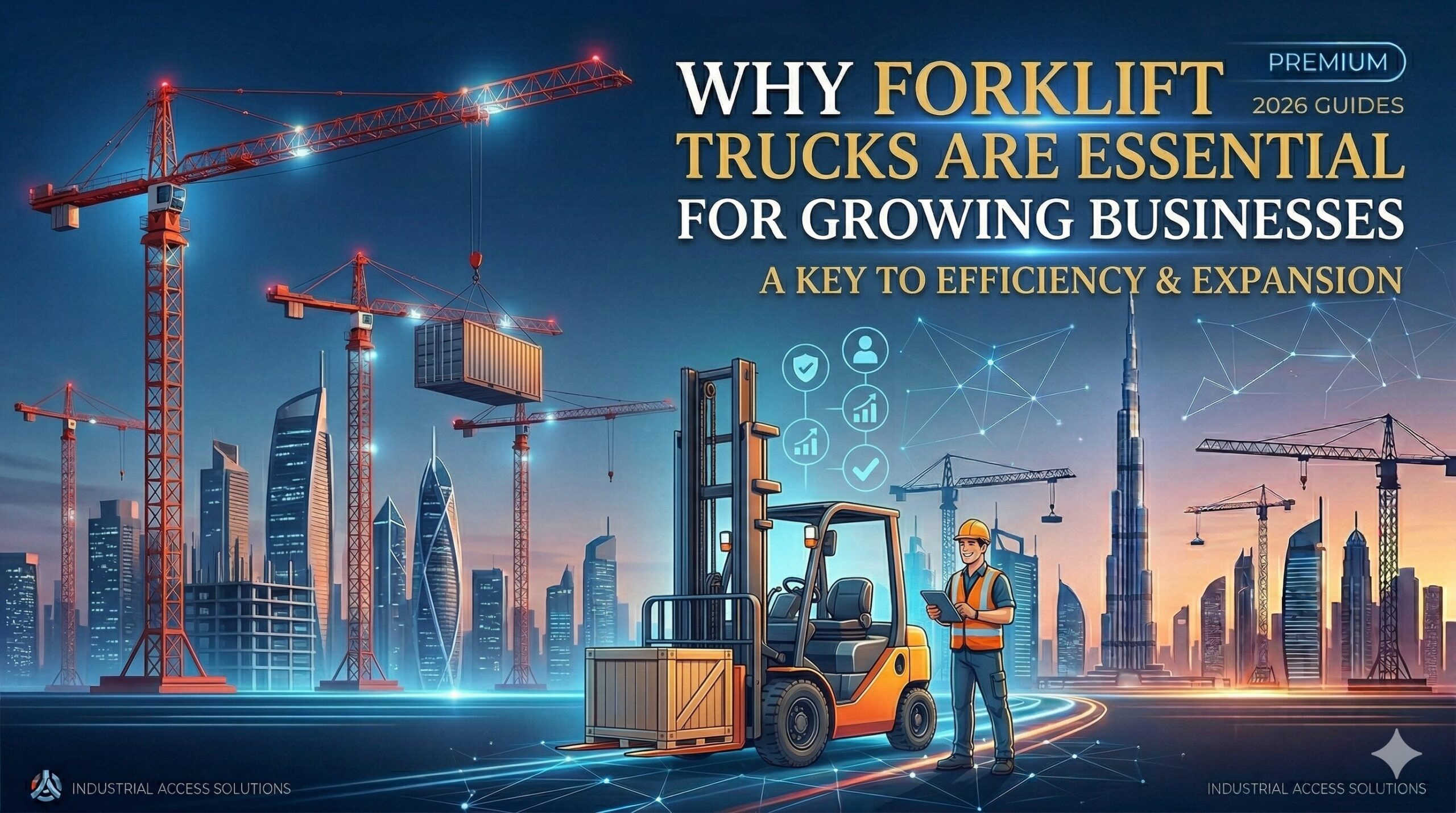
When a business starts growing — more stock, bigger orders, faster turnaround times — the pressure on warehouse and storage operations intensifies quickly. What once worked with a hand truck and a few extra staff hours suddenly becomes a bottleneck. That’s the moment most operations managers start seriously looking at a forklift truck for sale, and for good reason.
Forklift trucks aren’t just a piece of equipment. For small and mid-sized businesses scaling their logistics, they’re often the single biggest operational lever available.
3× – faster pallet movement vs manual handling
40% – reduction in warehouse labour costs reported by SMEs
18mo – average ROI payback period for first-time buyers
The Real Cost of Doing Without
Many growing businesses delay investing in material handling equipment because they’re watching cash flow carefully. That’s understandable. But the cost of not having a forklift is often invisible — it hides in overtime wages, stock damage, slower order fulfilment, and the physical limits of what your team can safely move in a day.
A warehouse without proper lifting equipment is a warehouse with a low ceiling on its own throughput. You can hire more staff, but human labour has hard physical limits — and costs that compound. A forklift doesn’t call in sick, doesn’t tire out in the third hour of a shift, and doesn’t require an additional three people to move a 1,000kg pallet.
“We were losing nearly four hours a day just on manual pallet movement. Once we had the right machine in place, we reclaimed that time immediately — and our order accuracy improved alongside it.”
How Forklifts Directly Improve ROI for SMEs
Return on investment from warehouse equipment isn’t always obvious on a spreadsheet, but it shows up in several concrete areas:
Labour efficiency
The most immediate saving. Tasks that require two or three workers and considerable time can be handled by one operator in a fraction of the time. Businesses that make the shift typically see labour cost reductions of 25–40% in their warehousing operations within the first year.
Vertical storage utilisation
Without a forklift, most businesses can only use the bottom few feet of their racking. A counterbalance or reach truck suddenly makes your existing floor space worth two or three times more, because you can stack to a height safely. That’s extra capacity without paying for more square footage.
Reduced stock damage
Dragging pallets, improvising lifts, and overloading manual equipment lead to product damage. Forklift trucks handle loads correctly and consistently. For businesses carrying high-value or fragile stock, the reduction in breakage alone can justify the investment within months.
Faster order fulfilment
The speed of movement through the warehouse directly affects how quickly orders leave the door. For e-commerce businesses, trade suppliers, or any operation competing on delivery time, this is a hard commercial advantage.
Buying vs Leasing: What Makes Sense for a Growing Business?
When exploring any forklift truck for sale, the question of ownership versus leasing comes up almost immediately. Both routes have merit depending on where your business is in its growth curve.
Buying outright (or via finance) makes sense if forklift use will be consistent and long-term. You own the asset, it appears on your balance sheet, and eventually the cost is fully absorbed. For businesses with predictable, high-frequency usage, the total cost of ownership is lower over five or more years.
Leasing or renting suits businesses in a period of rapid but uncertain growth. You preserve capital, avoid maintenance liability, and can upgrade the machine as your needs evolve. Many SMEs start with a short-term rental to validate their usage before committing to purchase.
Which Type of Forklift Does a Growing Business Actually Need?
Not all forklifts are the same, and buying the wrong type is a costly mistake. Here’s a quick orientation for SMEs:
Counterbalance forklift — the most common type, suitable for most general warehouse applications. Works both indoors and outdoors. Good for loading/unloading vehicles and moving heavy pallets across a yard.
Reach truck — designed for narrow aisles and high racking. Ideal for operations that need to maximise vertical storage in a constrained footprint. Indoor use only.
Pallet stacker (electric) — a lighter-duty option for businesses whose loads are moderate and whose warehouse is smaller. Lower cost, lower maintenance, easy to operate.
For most SMEs starting, a reliable used counterbalance forklift from a reputable dealer is the most practical first step. The used market is strong, and quality reconditioned machines offer the same core utility at a significantly lower entry cost.
The Safety Case
This one matters beyond pure economics. Manual handling injuries are among the most common workplace claims. A business that regularly asks staff to move heavy loads without proper equipment is carrying a legal and human risk that grows with volume. Investing in the right lifting solution is also an investment in your duty of care — and your employer’s liability insurance premiums may reflect it over time.
Frequently asked questions
Real questions from business owners on Reddit and Quora — answered.
Is it worth buying a forklift for a small business, or should I just hire labour?
It depends on your pallet volume. A rough rule of thumb: if you’re moving more than 20–30 pallets a day regularly, the cost of a forklift (even a used one) typically pays for itself within 12–18 months compared to the ongoing wage cost of manual handling. Below that threshold, hiring or renting on demand can make more sense. Many small business owners on Reddit’s r/smallbusiness note that the turning point came when overtime costs started hitting £1,000–£2,000/month — at that point, ownership math changes quickly.
What should I look for when buying a used forklift truck?
The most upvoted answer on Quora from a fleet manager: check the mast for cracks or wear, inspect the forks for bends or cracks at the heel (that’s the stress point), look at the hour meter (anything under 5,000 hours is generally considered low mileage for an industrial forklift), and ask for a full service history. Electric forklifts should have a battery health report. Always request a test drive — steering feel and lift speed tell you a lot. If buying privately, budget for an independent mechanical inspection.
How much does it cost to run a forklift annually, including maintenance?
Based on responses in r/Warehousing and r/logistics, annual running costs for a standard counterbalance forklift (LPG or diesel) typically fall between £1,500 and £3,500 per year for maintenance, servicing, and consumables, depending on usage intensity. Electric forklifts tend to be cheaper to maintain but require battery replacement every 5–7 years (cost: £2,000–£5,000). LOLER inspection (required by law in the UK every 6 months) adds around £150–£300. Fuel or electricity costs vary widely. Most operators budget £4,000–£6,000 per year all-in for a single machine in regular SME use.
Do I need a licence to operate a forklift in the UK, and how long does training take?
Yes. In the UK, operators must be trained and assessed as competent — this is a legal requirement under PUWER and HSE guidance, even though there is no nationally issued “licence” as such. The most recognised qualification is the RTITB or ITSSAR certificate. A basic counterbalance forklift course typically takes 3–5 days for a novice and costs £300–£600 per person. A Quora contributor who runs a logistics firm noted that building operator training costs into the upfront investment plan avoids a common SME mistake of buying equipment and then scrambling to legally staff it.
Thanks, www.monu.org