

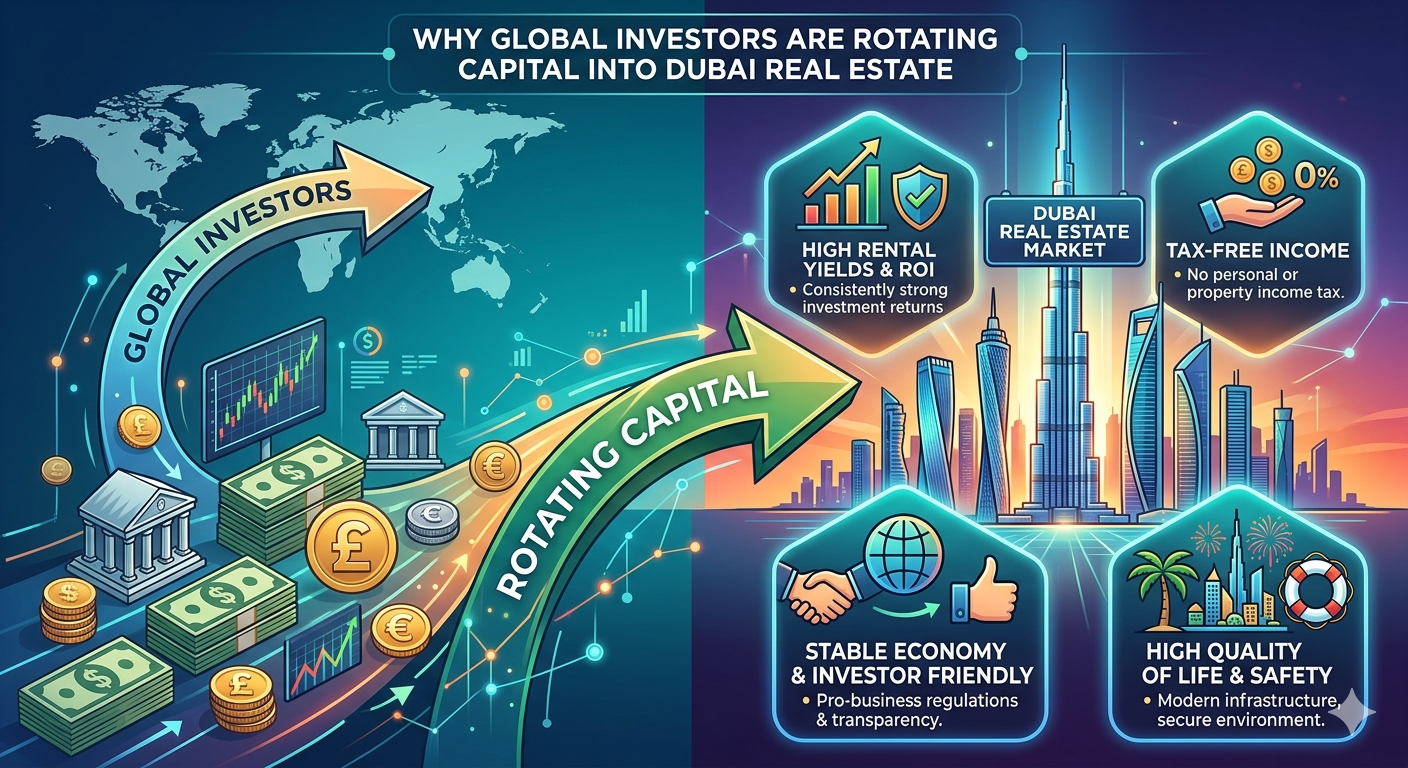
Somewhere between a record $187 billion in full-year transactions and a January 2026 that became the single largest sales month in the emirate’s history, the conversation around Dubai real estate changed. This is no longer a story about speculation or sun-seeking expats buying holiday apartments. Capital from Europe, Asia, India, and China is moving into Dubai with a deliberateness that signals a structural shift, not a trend. The drivers behind this rotation are specific, data-backed, and worth understanding before the window for early entry closes. Here is what the numbers actually show.
The Numbers That Changed the Conversation
January 2026 produced AED 72.4 billion in property sales, the highest single-month figure in Dubai’s recorded history, up 63 percent over January 2025. The first quarter of 2026, even accounting for a brief mid-quarter pause linked to regional uncertainty, is tracking above AED 120 billion in total transaction value.
These are not numbers propped up by easy credit or speculative flipping. According to Knight Frank, 86 percent of Dubai transactions in the first three quarters of 2025 were completed in cash. In January 2026 alone, cash purchases represented nearly 60 percent of total residential transaction value, approximately AED 43 billion. Cash-heavy markets behave differently when conditions shift. They do not seize up when interest rates move, and they do not amplify price drops when credit tightens.
The full 2025 data confirms the trajectory. The Dubai Land Department recorded 205,100 residential sales transactions, an 18 percent increase in volume over 2024, with total value reaching AED 539.9 billion, up nearly 25 percent year-on-year. Over the past five years, cumulative transactions in Dubai have crossed AED 2 trillion. These are global-city-level figures, and the pace has been accelerating.
The Case That Keeps Winning the Comparison
When investors stack Dubai against established real estate markets, the numbers do the work. London prime residential yields average around 3.5 percent. New York is in a similar range. Singapore rarely breaks 3 percent. Dubai generates gross rental yields of 7 to 9.5 percent across mid-market apartments, and a city-wide average of 6.7 percent, based on Global Property Guide data from late 2025.
Add the tax structure and the arithmetic shifts further. There is no income tax on rental earnings, no capital gains tax on disposal, and no inheritance tax. An investor buying in London or Mumbai hands a significant portion of those returns back in tax. In Dubai, that money stays in the portfolio.
The regulatory environment has matured significantly. The Real Estate Regulatory Agency enforces escrow account protections, mandatory developer registration, and transparent dispute resolution. The Dubai Land Department has undergone a digital transformation that makes transaction records among the most accessible in the MENA region. For international investors who were once cautious about emerging-market risk, that evolution matters.
The Golden Visa program adds a non-financial dimension to the case. Property investors committing AED 2 million or above receive a 10-year residency visa. For families in politically unstable or economically pressured environments, this is genuine optionality: the legal right to move without having to move.
A structured breakdown of how these factors interact with real investment returns is covered in this Dubai property investment guide for 2026 , which walks through yield calculations, fee structures, and visa thresholds by property type.
Who Is Actually Buying, and What That Reveals ?
The buyer profile in Dubai has diversified considerably over the past two years. Indian investors remain the largest single nationality, though their approach has shifted from momentum-driven to long-term holding. European buyers from the UK, France, Germany, and Russia account for a meaningful share of luxury and waterfront transactions. Chinese buyers have been increasing their presence since early 2026, driven partly by US-China trade friction and the appeal of a politically neutral, USD-pegged market with no capital controls on entry.
This breadth matters for risk assessment. A market dominated by one buyer nationality is exposed to that country’s economic cycles. Dubai has built a buyer pool spanning more than 180 nationalities, making it structurally resilient in a way most single-country real estate markets are not.
Off-plan sales accounted for approximately 71 percent of total transaction volume in early 2026. In most mature markets, buyers strongly prefer completed assets. Dubai’s off-plan dominance reflects developer credibility and payment structures investors find compelling: many projects allow 40 to 60 percent of the purchase price to be paid post-handover. For investors, this means deploying less capital upfront while locking in early entry pricing.
At the ultra-luxury end, 990 homes priced above AED 10 million were sold in January 2026 alone. High-net-worth buyers, historically the most sensitive to uncertainty, have not withdrawn from the market.
Institutional behaviour is telling the same story. Data from Knight Frank shows short-term resale activity has dropped to approximately 4 percent of total transactions, compared to around 25 percent during the market’s speculative peak. The buyer pool is becoming structurally different: more long-term, more diversified, and less dependent on momentum.
For a granular view of how yields differ across communities and unit types, this rental yield analysis by community offers the data that broad city averages tend to obscure.
The Honest Risk Picture
No market argument is complete without acknowledging the stress points. Dubai faces a significant supply pipeline. More than 120,000 units are officially scheduled for delivery in 2026, and while industry estimates suggest only around 48 percent will be handed over on schedule, absorption capacity is being tested. Moody’s, in a March 2026 forecast, projected a moderate correction in mid-market apartment segments beginning in late 2026.
The price growth seen between 2020 and 2025, with median apartment prices rising from around AED 1.2 million to AED 2.1 million, is unlikely to repeat at the same pace. The market is entering what analysts call a maturity phase. That means buyers with genuine end-use or long-term investment intent face less speculative competition and cleaner entry conditions.
Structural demand remains intact. Dubai’s population has crossed 4 million, with net annual inflows of around 100,000 people. UAE GDP growth for 2026 is projected at 5.6 percent, the highest among GCC countries. Cash deal dominance provides a buffer that credit-dependent markets simply do not have.
The rotation into Dubai real estate is deliberate and data-backed. The risks are real but clearly defined. For investors comparing alternatives, holding cash, navigating inflated Western markets, or returning to economies under their own structural pressure, Dubai’s fundamentals remain hard to set aside.
Capital rotation into Dubai is not built on momentum or hype. It is backed by yield data, cash transaction dominance, a diversified international buyer base, and a regulatory framework that has earned institutional-level trust. The market is maturing, and that tends to benefit investors who focus on fundamentals over timing. The question is no longer whether Dubai belongs in the portfolio. It is which segment, which community, and what timeline makes sense for the cycle ahead.
About the Author
Naina-singh is a Dubai-based real estate writer covering the UAE property market for global investors and expats. With a focus on data-backed analysis, she publishes guides on off-plan strategy, rental yield performance, and Golden Visa investment pathways. Research and market commentary are regularly updated at DubaiPropertyInsight.com.