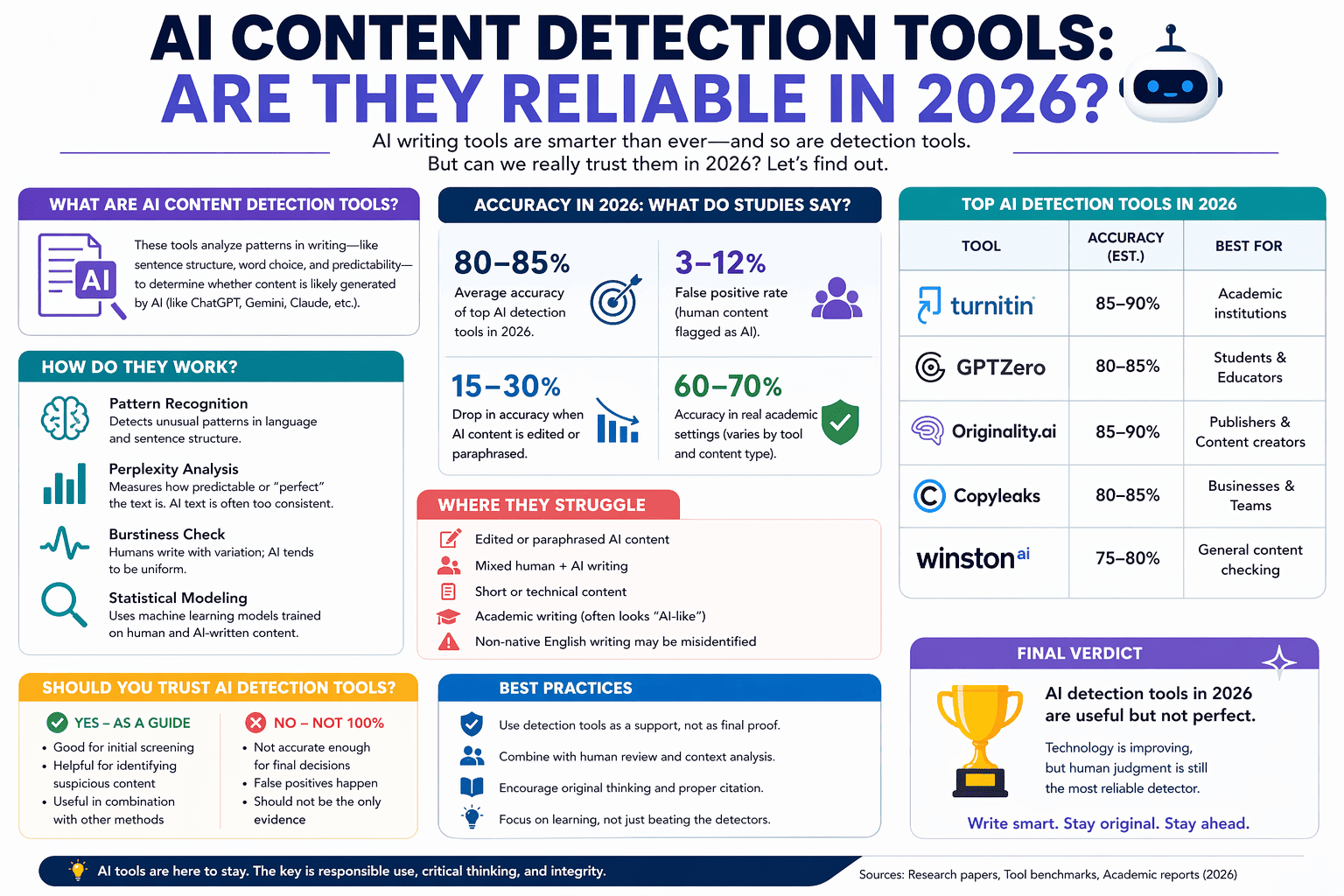
With the explosion of AI tools like ChatGPT, Gemini, and Claude, detecting AI-generated content has become a major concern in education, publishing, and research. Tools like Turnitin, GPTZero, and Originality.ai promise to identify AI-written text—but the real question is:
👉 Can we actually trust AI detection tools in 2026?
Let’s break it down with facts, research, and real-world insights.
🔍 The Short Answer: Partially Reliable, Not Perfect
AI detection tools in 2026 are:
- ✅ Useful for identifying clear AI-written text
- ❌ Not fully reliable for final judgment
Research shows that no tool consistently achieves 100% accuracy across all types of content.
📊 Real Accuracy Numbers (2026 Data)
Here’s what studies and testing reveal:
- Most tools achieve 80–85% accuracy at best
- Detection drops significantly for edited or mixed content
- False positives (human text flagged as AI) range from 3% to 12%
- Some tools perform as low as 60–70% accuracy in real academic settings
👉 Conclusion: These tools are helpful indicators, not proof.
🧠 Why AI Detection Tools Struggle
1. AI is Getting Smarter
Modern AI tools can:
- Mimic human tone
- Add variation in writing
- Avoid predictable patterns
This makes detection harder over time.
2. Edited Content Breaks Detection
Even small changes can reduce detection accuracy:
- Light paraphrasing drops accuracy by 15–30%
- Mixed (AI + human) content is hardest to detect
3. False Positives Are a Serious Issue
Sometimes tools flag real human writing as AI.
- Non-native English writers are more likely to be flagged
- Academic writing style often looks “AI-like”
👉 This creates fairness concerns in education.
4. Context Matters (But Tools Ignore It)
AI detectors analyze:
- Sentence patterns
- Predictability
- Writing structure
But they don’t understand intent or originality like humans do.
⚠️ Real-World Problems in 2026
- Students are being wrongly accused due to detection errors
- New AI models are becoming harder to detect
- Even detection tools sometimes misclassify real content as AI
👉 This shows the technology is still evolving and imperfect.
🧪 What AI Detection Tools Are Good At
They work best for:
- Fully AI-generated (unedited) content
- Large text samples
- Identifying patterns in simple writing
Some tools can reach 90%+ accuracy in these cases
❌ Where They Fail
AI detectors struggle with:
- Edited or paraphrased AI content
- Mixed human + AI writing
- Technical or academic writing
- Short text samples
In some cases, accuracy can drop below 50% for complex scenarios
🧠 Expert Insight: Why Detection is So Hard
Academic research shows that:
- AI detectors often rely on surface patterns, not true understanding
- They fail when writing style changes or context shifts
- Performance drops in real-world scenarios vs lab tests
👉 In simple terms:
They guess based on patterns—they don’t “know” for sure.
🎯 So, Should You Trust AI Detectors?
✔️ YES — Use Them As a Guide
- Helpful for identifying suspicious content
- Good for initial screening
❌ NO — Don’t Rely on Them Alone
- Not accurate enough for final decisions
- Should not be the only evidence
✅ Best Way to Use AI Detection Tools
Use them smartly:
- Combine with human review 👀
- Check writing style consistency
- Look for citations and originality
- Use as a support tool, not judge
🚀 Final Verdict (2026 Reality)
AI detection tools in 2026 are:
👉 Useful but not reliable enough to be trusted blindly
They are improving—but still face major challenges like:
- False positives
- Evasion by AI tools
- Difficulty detecting hybrid content
💡 Final Advice
Whether you’re a student, researcher, or content creator:
- Don’t depend only on AI tools
- Focus on original writing and clear understanding
- Use AI responsibly—as a helper, not a shortcut
AI detection is evolving… but human judgment is still the most reliable tool ✅