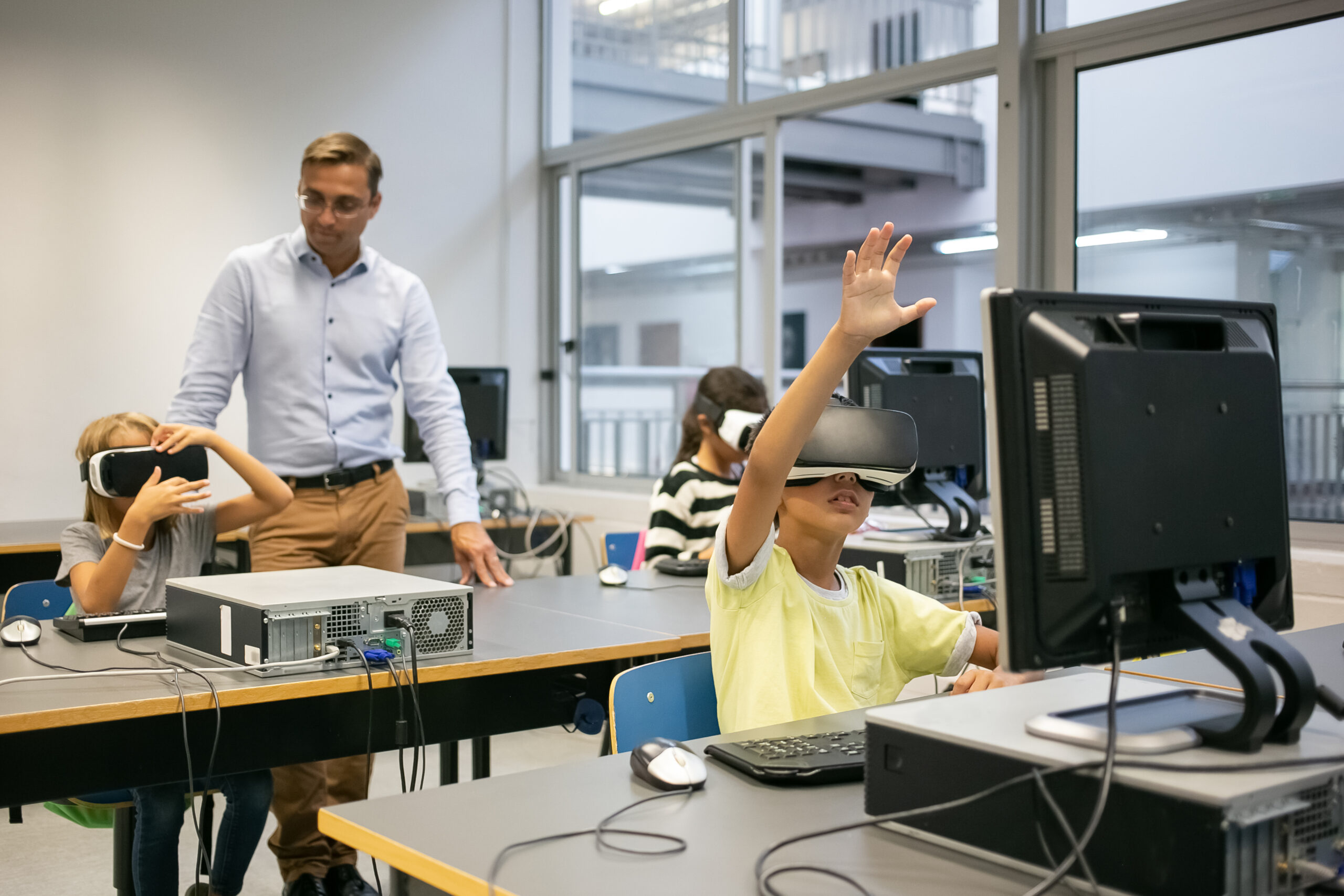
When I walk into a school today, I often have a moment of déjà vu. Sure, the dusty overhead projectors are gone, replaced by gleaming interactive smartboards. The squeak of chalk has been silenced by the click of a keyboard. But if you look past the hardware, the fundamental structure of the classroom often looks exactly as it did twenty years ago.
We’ve spent the last decade equipping our K-12 schools with incredible tools, yet we’re still trying to fit those tools into an industrial-age model of education. We’re digitizing the old way of doing things rather than embracing true digital transformation in K-12 schools.
As someone who has spent years analyzing the intersection of technology and public service, I’ve seen a pattern emerge. We tend to treat technology like a Band-Aid. Is a student struggling? Give them a tablet. Is a teacher overwhelmed? Buy them a new app. But real transformation isn’t about the gadget; it’s about the ecosystem. It’s about recognizing that the walls between a K-12 classroom, a university lecture hall, and a government agency are becoming thinner by the day, and if we want to prepare students for the future, we need to start acting like it.
The K-12 Conundrum: Personalization vs. Standardization
The biggest challenge I see in K-12 right now is the tension between standardization and personalization. We have state standards, standardized tests, and standardized schedules. Yet, we are asking teachers to treat every student as an individual.
This is where digital transformation stops being a buzzword and starts being a lifeline. True digital transformation in K-12 schools means using data not to rank students, but to understand them. It means moving away from the “one-size-fits-all” textbook model and toward adaptive learning platforms that allow a seventh-grader to work on grade-level math in the morning and remediation for foundational gaps in the afternoon, all within the same classroom.
But schools can’t do this in a vacuum. They are often hamstrung by legacy systems that don’t talk to each other. The platform that tracks attendance doesn’t integrate with the platform that tracks reading levels, which doesn’t integrate with the platform parents use to communicate with teachers. When systems are siloed, the student experience becomes fragmented.
Bridging the Gap with Higher Education
This fragmentation follows students long after they toss their graduation caps in the air. There is a massive disconnect between how we teach in high school and how we expect students to learn in college.
I’ve spoken to university administrators who bemoan the fact that freshmen arrive on campus with high school diplomas but without the digital literacy skills needed to navigate a modern university ecosystem. Meanwhile, universities are investing heavily in higher education technology solutions from AI-driven advising bots to complex learning management systems that assume a level of autonomy many high school graduates simply haven’t developed yet.
What if we started bridging that gap earlier?
Imagine a consortium where a local school district partners with a state university to align their tech stacks. Instead of a high school senior learning on one set of collaboration tools and being thrown into a completely alien system in their first semester of college, there is continuity. We are seeing innovative higher education technology solutions that offer dual-enrollment courses hosted on cloud-based platforms accessible to both high school juniors and university sophomores. This isn’t just about making life easier for IT departments; it’s about leveling the playing field.
When we align K-12 and higher education through shared technology standards, we reduce the friction that often causes first-generation college students to stumble. We create a seamless pipeline where the data that tracks a student’s progress with their consent, of course, can help inform the advising they receive the day they set foot on a college campus.
The Missing Piece: Government as a Partner
Of course, none of this is possible without looking at the third pillar of this ecosystem: the public sector. For too long, educators have viewed government IT solutions as the enemy of innovation. We associate government tech with bureaucracy, red tape, and systems that crash during standardized testing week.
But that perspective is outdated. The truth is, the most successful digital transformation initiatives happening right now are those where local education agencies (LEAs) are partnering with state governments to build infrastructure, rather than trying to build it alone.
We need to rethink government IT solutions not as rigid mandates, but as the foundational plumbing. Just as a city doesn’t ask each neighborhood to build its own water filtration system, a state shouldn’t ask every school district to build its own cybersecurity infrastructure from scratch.
I recently looked at a state initiative where the government centralized identity management for all public schools. Instead of 500 different districts trying to manage password resets, single sign-on, and phishing protection on their own (often with insufficient budgets), the state provided a secure, enterprise-grade backbone. This is the kind of government IT solutions approach that actually empowers educators. It takes the burden of compliance and security off the shoulders of teachers and IT specialists who are already stretched thin, allowing them to focus on instruction rather than troubleshooting.
The Human Element
If there is one thing I want readers to take away from this, it’s that technology is only as good as the trust we place in it.
When we talk about digital transformation in K-12 schools, we have to talk about the parents who are terrified that screens are replacing human connection. When we talk about higher education technology solutions, we have to talk about the professors who feel they are competing with AI for their students’ attention. And when we talk about government IT solutions, we have to talk about the citizens who worry that digitization means depersonalization.
We have to design with empathy.
The goal isn’t to create a fully automated education system. The goal is to use technology to automate the mundane so that humans can focus on the meaningful. Let the government IT solution handle the secure data transfer so the school counselor has more time to talk to a student about their anxiety. Let the higher education AI tutor handle the basic algebra drills so the professor can spend office hours having deep philosophical discussions. Let the K-12 adaptive learning software handle the differentiated instruction so the teacher can sit on the rug and actually read with a small group of first graders.
Looking Ahead
We are standing at a crossroads. We can either continue to buy point solutions, a new app here, a new device there, without a cohesive strategy, or we can embrace a holistic vision.
That vision looks like this: a K-12 system that uses secure, government-backed infrastructure to give students a personalized learning journey that prepares them for the rigor of higher education. It looks like universities are using scalable technology to meet students where they are, rather than where we expect them to be. And it looks like government agencies are acting as enablers, providing the secure, reliable, and equitable foundation that makes all of this possible.
The future of education isn’t about choosing between human touch and digital efficiency. It’s about using the latter to amplify the former. Let’s stop chasing the next shiny gadget and start building the connected, compassionate ecosystem our students actually deserve.