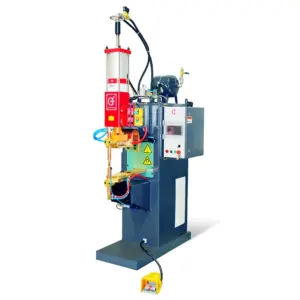
In today’s competitive manufacturing landscape, efficiency, precision, and reliability are non-negotiable. For assembly lines handling sheet metal, automotive components, and complex metal structures, the projection welder has emerged as a crucial tool in achieving consistent, high-quality welds. Heron Welder, a global leader in industrial welding and metal-joining solutions, offers advanced projection welding systems designed for OEMs, automation integrators, and factory engineers looking to optimize production performance.
What is a Projection Welder?
A projection welder is a type of resistance welding machine that joins metal components at precise points called projections. Unlike standard spot welding, which requires direct electrode contact at each weld site, projection welding uses raised features on one of the components (projections) to concentrate the electrical current and pressure exactly where the weld is desired. This results in:
- Controlled weld energy
- Minimal material distortion
- High repeatability across production runs
By focusing heat and pressure only on the projections, manufacturers can achieve stronger welds with less surface marking, making it ideal for automotive, appliance, and heavy machinery assemblies.
How Projection Welding Works
Projection welding combines heat, pressure, and time to join metal parts efficiently. The process can be broken down into three key steps:
- Preparation and Fixturing
The workpieces, often stamped sheet metal parts, are aligned in a fixture so that projections on one part align with the mating surface of the other part. Proper fixturing ensures consistent weld quality and repeatability. - Application of Force and Current
Electrodes press the components together while a high-amperage current passes through the projections. The projections act as localized resistance points, heating up rapidly due to the electrical resistance of the metal. - Formation of the Weld Nugget
The projection melts and flows under pressure, forming a solid weld nugget at each designated location. After cooling, the joint is strong, precise, and free of significant surface blemishes.
Heron’s projection welders are engineered to deliver consistent current control, programmable weld parameters, and integrated quality monitoring, ensuring optimal results even in automated production lines.
Common Applications of Projection Welders
Projection welding is widely adopted across industries where precision and repeatable quality are paramount. Typical applications include:
- Automotive Manufacturing
Welding of brackets, chassis components, reinforcement plates, and battery packs. - Appliance and Electronics
Joining sheet metal frames, housings, and structural components in home appliances and electronics enclosures. - Heavy Machinery and Industrial Equipment
Fabrication of structural frames, support brackets, and load-bearing assemblies. - Metal Furniture and HVAC Components
Efficiently welding repetitive patterns on ducts, panels, and furniture frames.
Heron Welder’s systems can be customized with MFDC (Medium-Frequency Direct Current) or AC/DC controls, robotic integration, and automated feeding systems to support high-volume, precision welding for these applications.
Projection Welder vs. Spot Welder: Understanding the Difference
Although often confused, projection welding and spot welding have distinct advantages:
| Feature | Projection Welding | Spot Welding |
|---|---|---|
| Contact Points | Concentrated at projections | Direct electrode contact |
| Material Thickness | Can handle thicker or multiple layers | Limited to thinner sheets |
| Weld Strength | Higher due to localized nugget formation | Adequate for light assemblies |
| Surface Distortion | Minimal | Can cause marking and deformation |
| Automation Suitability | Excellent for repetitive, multi-point welds | Suitable for simple assembly tasks |
For complex assemblies with multiple weld points, projection welding reduces cycle time and ensures uniform strength, making it a preferred choice for modern production lines.
Best Practices for Projection Welding
Optimizing a projection welding process requires attention to several key factors:
- Projection Design – Ensure projections are correctly sized, uniformly distributed, and compatible with the material thickness.
- Electrode Maintenance – Keep electrodes clean, well-shaped, and properly aligned to maintain consistent weld quality.
- Parameter Control – Carefully set current, force, and weld time for each application. Heron’s programmable controllers simplify this process.
- Fixturing and Alignment – Use precise fixtures to maintain consistent contact and prevent misalignment.
- Quality Monitoring – Integrate real-time monitoring to detect anomalies and ensure every weld meets strength requirements.
By following these guidelines, manufacturers can maximize productivity, reduce scrap, and maintain high-quality standards.
Why Choose Heron Welder for Projection Welding?
Heron Welder has decades of experience designing and manufacturing industrial welding systems for global OEMs and automation integrators. Key advantages of choosing Heron projection welders include:
- Customized Automation – Robotic integration and production line solutions tailored to your workflow.
- Advanced Control Systems – MFDC, AC/DC, or capacitor discharge options for precise, repeatable welding.
- Global Support – Expert guidance, spare parts, and service to minimize downtime.
- Full Range of Metal-Joining Solutions – Combine projection welding with spot welding, clinching, or FSPR in multi-process lines for maximum efficiency.
Heron is trusted by manufacturing engineers worldwide for delivering reliable, high-performance projection welders that scale with production demands.
FAQs About Projection Welding
1. Can projection welding handle thick materials?
Yes. Projection welding is ideal for thicker or multi-layered components where standard spot welding may struggle.
2. What types of metals can be welded?
Projection welding works with carbon steel, stainless steel, aluminum, and certain alloys, depending on electrode configuration and current settings.
3. Is projection welding suitable for automation?
Absolutely. Projection welders integrate seamlessly with robotic systems, conveyors, and automated feeding equipment.
4. How do I ensure weld quality?
Proper projection design, electrode maintenance, and real-time monitoring are essential. Heron systems include programmable controls for consistent results.
5. What industries benefit most from projection welding?
Automotive, appliance, electronics, heavy machinery, and HVAC manufacturing are the primary industries leveraging projection welding for efficiency and strength.
Take the Next Step with Heron Projection Welders
Modern manufacturing requires precision, reliability, and automation-ready welding solutions. Heron Welder’s projection welding systems deliver all three—helping engineers, OEMs, and production managers achieve faster cycle times, higher weld quality, and seamless integration into automated lines.
Request a consultation or quote today to explore custom projection welding solutions tailored to your production needs. Partner with Heron to elevate your manufacturing efficiency and ensure every weld meets the highest standards.