


India’s education system is undergoing a major transformation with the introduction of the National Education Policy (NEP) 2020. One of its most significant reforms is the 5+3+3+4 education structure, which replaces the traditional 10+2 system.
This new framework is designed to align education with the cognitive development of children while focusing on skills, creativity, and holistic learning rather than rote memorization.
In this article, you’ll get a clear understanding of the 5+3+3+4 model, its stages, benefits, and how it reshapes the future of education in India.
What is the 5+3+3+4 Education System?
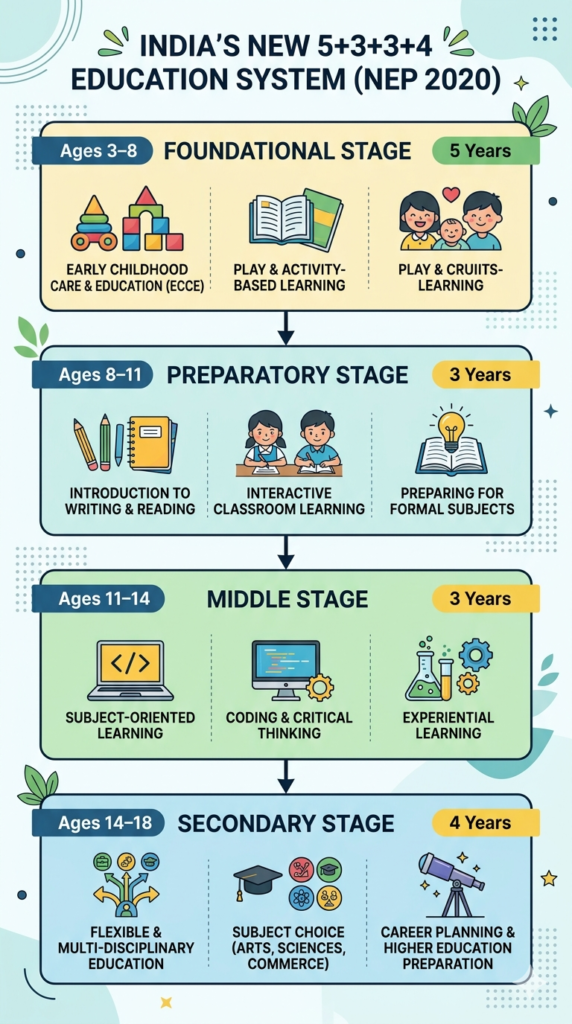
The 5+3+3+4 structure is a new school education model introduced under NEP 2020. It divides schooling into four stages based on age groups and learning needs:
- 5 Years – Foundational Stage (Ages 3–8)
- 3 Years – Preparatory Stage (Ages 8–11)
- 3 Years – Middle Stage (Ages 11–14)
- 4 Years – Secondary Stage (Ages 14–18)
Unlike the old system, this model integrates early childhood education and emphasizes conceptual understanding and skill development at every level.
Stage-wise Breakdown of the 5+3+3+4 System
1. Foundational Stage (5 Years)
This stage includes:
- 3 years of pre-primary (Nursery, LKG, UKG)
- Classes 1 and 2
Focus Areas:
- Play-based and activity-based learning
- Language development (mother tongue/local language)
- Social and emotional skills
This stage builds the foundation for lifelong learning through fun and interactive methods.
2. Preparatory Stage (3 Years)
Includes Classes 3 to 5 (Ages 8–11)
Focus Areas:
- Reading, writing, and basic mathematics
- Introduction to science and social studies
- Discovery-based and interactive learning
Teaching methods shift gradually from play-based to more structured classroom learning.
3. Middle Stage (3 Years)
Includes Classes 6 to 8 (Ages 11–14)
Focus Areas:
- Conceptual understanding of subjects
- Introduction to coding and vocational education
- Critical thinking and analytical skills
Students begin exploring subjects in depth and gain practical exposure.
4. Secondary Stage (4 Years)
Includes Classes 9 to 12 (Ages 14–18)
Focus Areas:
- Multidisciplinary subject choices
- Flexibility in combining streams (Arts, Science, Commerce)
- Skill-based and career-oriented learning
Students are no longer restricted to a single stream and can choose subjects based on their interests.
Why Was the 5+3+3+4 System Introduced?
The traditional 10+2 system focused heavily on memorization and exam performance, leaving little room for skill development.
The new system was introduced to:
- Promote critical thinking and problem-solving
- Encourage practical and experiential learning
- Reduce reliance on rote learning
- Bridge the gap between education and employability
This reform aims to prepare students for real-world challenges and future careers.
Key Benefits of the 5+3+3+4 Model
The new structure offers several advantages:
✔ Holistic Development
Focus on academics, skills, sports, and creativity
✔ Early Skill Building
Vocational education begins from Class 6
✔ Flexible Learning
Students can choose subjects across streams
✔ Strong Foundation
Emphasis on early childhood education
✔ Career Readiness
Practical exposure and multidisciplinary learning
✔ Improved Critical Thinking
Encourages analytical and problem-solving abilities
5+3+3+4 vs 10+2 System: What’s Changed?
| Aspect | Old 10+2 System | New 5+3+3+4 System |
|---|---|---|
| Structure | 10 years + 2 years | 4 developmental stages |
| Early Education | Not included | Included (Ages 3–8) |
| Learning Style | Rote learning | Experiential learning |
| Subject Choice | Limited | Flexible and multidisciplinary |
| Skill Development | Minimal | Strong focus |
| Assessment | Exam-based | Competency-based |
Key Highlights of NEP 2020
Apart from the new structure, NEP 2020 introduces several reforms:
- Holistic Progress Card for overall student evaluation
- PARAKH for standardized assessment
- Academic Bank of Credits (ABC) for digital learning records
- Increased education spending to 6% of GDP
- Emphasis on teacher training and digital learning
- Promotion of multilingual education
Challenges in Implementation
While the policy is promising, some challenges remain:
- Lack of infrastructure in rural areas
- Need for teacher training
- Limited access to technology
- Resistance to change
- Language adaptation issues
Effective implementation will require collaboration between governments, schools, and educators.
Future of the 5+3+3+4 Education System
The 5+3+3+4 model is expected to transform India’s education landscape in the coming years. With increased adoption of:
- Digital classrooms
- AI-powered learning tools
- Skill-based curriculum
students will be better prepared for global opportunities and future careers.
Conclusion
The 5+3+3+4 education system under NEP 2020 marks a significant shift from traditional learning methods to a more student-centric, flexible, and skill-oriented approach.
By focusing on early learning, critical thinking, and multidisciplinary education, it aims to create a generation that is not only academically strong but also future-ready.
FAQs
Q1. What is the 5+3+3+4 system?
It is a new education structure under NEP 2020 dividing schooling into four stages based on age and development.
Q2. What are its main benefits?
It promotes holistic development, flexibility, and early skill-building.
Q3. Does it replace the 10+2 system?
Yes, it completely replaces the traditional 10+2 structure.