
Organizations across manufacturing, healthcare, logistics, and service industries are under constant pressure to reduce costs, improve quality, and deliver consistent results. This is where lean six sigma consulting becomes a powerful strategy. By combining Lean principles (waste reduction) with Six Sigma methodologies (defect reduction), businesses can achieve measurable improvements in performance and profitability.
However, many decision-makers ask the same questions before investing: How much does Lean Six Sigma consulting cost? What ROI can we expect? And what does the process actually look like? This guide answers those questions in detail, helping you understand the real value behind Lean Six Sigma consulting.
What Is Lean Six Sigma Consulting?
Lean Six Sigma Consulting involves working with process improvement experts who use structured methodologies to optimize business operations. The approach combines:
- Lean Manufacturing: Focused on eliminating waste and improving workflow
- Six Sigma: Focused on reducing variation and defects using data-driven analysis
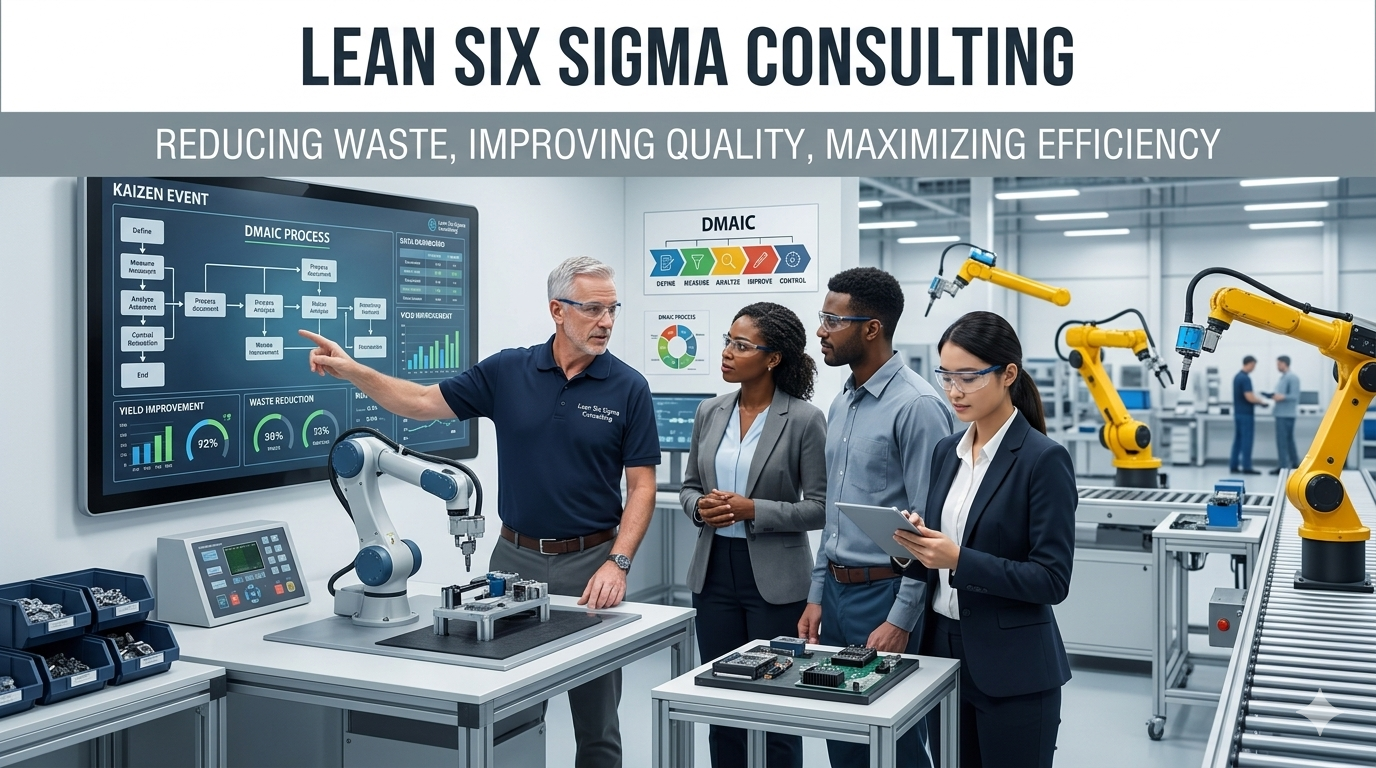
Consultants apply frameworks such as DMAIC (Define, Measure, Analyze, Improve, Control) to identify inefficiencies, implement solutions, and sustain long-term improvements.
Understanding the Cost of Lean Six Sigma Consulting
The cost of Lean Six Sigma consulting can vary widely depending on several factors, including company size, project scope, and complexity.
1. Key Factors That Influence Cost
- Project scope: Small process improvements cost less than enterprise-wide transformations
- Industry complexity: Highly regulated industries (e.g., healthcare, aerospace) may require more expertise
- Duration of engagement: Short-term projects vs. long-term consulting partnerships
- Level of customization: Tailored solutions often cost more than standardized approaches
2. Typical Pricing Models
Most consulting firms use one of the following pricing structures:
- Project-based pricing – Fixed cost for a defined scope
- Hourly or daily rates – Flexible pricing based on consultant time
- Retainer model – Ongoing support for continuous improvement initiatives
3. Estimated Cost Range
- Small projects: $5,000 – $25,000
- Mid-sized initiatives: $25,000 – $100,000
- Enterprise transformation: $100,000+
While these figures may seem significant, the long-term value often outweighs the initial investment.
Measuring ROI from Lean Six Sigma Consulting
Return on investment (ROI) is one of the strongest arguments for adopting Lean Six Sigma Consulting. Unlike many business initiatives, process improvement efforts produce measurable financial and operational results.
1. Cost Savings
Lean Six Sigma reduces waste, defects, and inefficiencies, leading to:
- Lower production costs
- Reduced rework and scrap
- Decreased labor inefficiencies
- Optimized resource utilization
2. Increased Productivity
By improving workflows and eliminating bottlenecks, organizations can:
- Increase output without additional resources
- Reduce cycle times
- Improve on-time delivery rates
3. Quality Improvements
Six Sigma methodologies focus on reducing defects and improving consistency, which results in:
- Higher product quality
- Fewer customer complaints
- Improved brand reputation
4. Revenue Growth
Improved efficiency and quality lead to:
- Better customer satisfaction
- Increased customer retention
- Higher sales and profitability
5. Typical ROI Expectations
Many organizations report ROI ranging from 3x to 10x their initial investment within the first year of implementation.
What to Expect from a Lean Six Sigma Consulting Engagement
Understanding the consulting process helps set realistic expectations and ensures alignment with business goals.
1. Initial Assessment and Discovery
The engagement begins with a detailed analysis of your current operations, including:
- Process mapping
- Performance metrics review
- Identification of inefficiencies
- Stakeholder interviews
This phase establishes a baseline for improvement.
2. Defining Goals and KPIs
Consultants work with your team to define clear objectives, such as:
- Reducing cycle time by a specific percentage
- Lowering defect rates
- Improving production efficiency
- Cutting operational costs
KPIs are established to measure progress and success.
3. Implementation Using DMAIC Framework
Lean Six Sigma projects typically follow the DMAIC methodology:
- Define: Identify the problem
- Measure: Collect relevant data
- Analyze: Identify root causes
- Improve: Implement solutions
- Control: Sustain improvements
This structured approach ensures systematic and data-driven decision-making.
4. Employee Training and Engagement
A key part of Lean Six Sigma Consulting is knowledge transfer. Consultants often provide:
- Lean Six Sigma training (Yellow Belt, Green Belt, Black Belt)
- Workshops and Kaizen events
- Continuous improvement coaching
This empowers employees to maintain and expand improvements independently.
5. Monitoring and Continuous Improvement
After implementation, consultants help monitor performance and ensure sustainability by:
- Tracking KPIs
- Conducting regular audits
- Refining processes as needed
Continuous improvement becomes part of the organizational culture.
Industries That Benefit from Lean Six Sigma Consulting
Lean Six Sigma is highly versatile and applicable across industries, including:
- Manufacturing
- Healthcare
- Logistics and supply chain
- Financial services
- IT and software development
- Retail and eCommerce
Any organization with repeatable processes can benefit from Lean Six Sigma consulting.
Common Challenges and How Consultants Address Them
Resistance to Change
Employees may resist new processes. Consultants address this through training, communication, and involvement.
Lack of Data
Without accurate data, improvement efforts fail. Lean Six Sigma emphasizes data collection and analysis.
Sustainability Issues
Improvements may fade over time. The “Control” phase ensures long-term success through monitoring and standardization.
FAQs
1. What does Lean Six Sigma Consulting include?
Lean Six Sigma Consulting includes process analysis, waste reduction, defect elimination, workflow optimization, employee training, and continuous improvement strategies.
2. How long does a Lean Six Sigma project take?
Project timelines vary but typically range from a few weeks for small improvements to several months for complex, organization-wide transformations.
3. Is Lean Six Sigma Consulting worth the cost?
Yes, most organizations achieve significant cost savings, improved efficiency, and higher ROI, often exceeding their initial investment.
4. What industries use Lean Six Sigma Consulting?
Manufacturing, healthcare, logistics, finance, IT, and retail industries commonly use Lean Six Sigma to improve performance and reduce costs.
5. Do small businesses benefit from Lean Six Sigma Consulting?
Absolutely. Small and mid-sized businesses can achieve substantial improvements in efficiency, cost reduction, and scalability through Lean Six Sigma practices.
Final Thoughts
Lean Six Sigma Consulting offers a structured, data-driven approach to solving complex operational challenges. While the initial cost may vary depending on scope and complexity, the long-term ROI—through cost savings, improved efficiency, and enhanced quality—makes it a worthwhile investment.
By understanding what to expect from the process, businesses can approach Lean Six Sigma consulting with confidence and clarity. Whether your goal is to reduce waste, improve productivity, or build a culture of continuous improvement, Lean Six Sigma provides the tools and expertise needed to achieve sustainable success.
For organizations committed to operational excellence, Lean Six Sigma Consulting is not just an option—it’s a strategic advantage.