

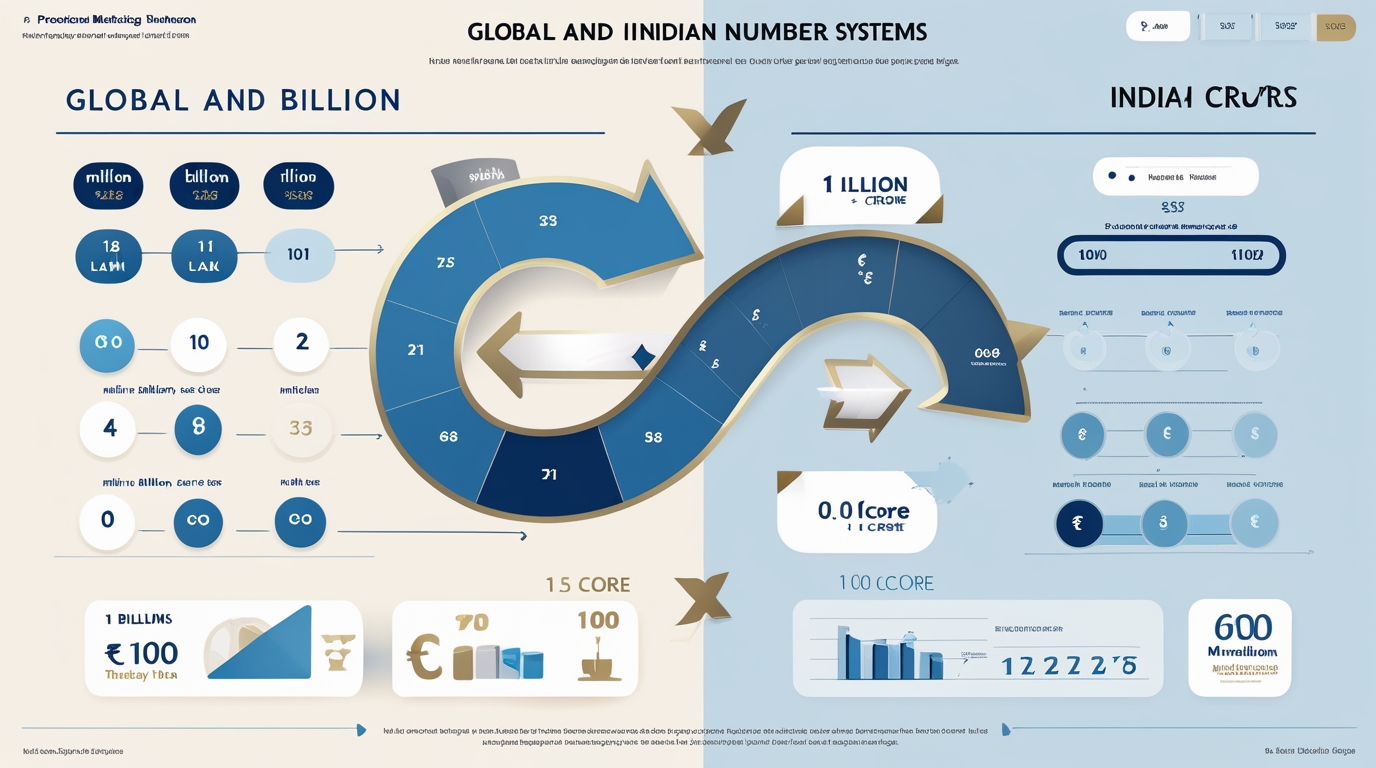
Understanding large numbers can be confusing, especially when switching between global and Indian numbering systems. Terms like billion, million, and trillion are commonly used in international finance, economics, and media, while India primarily uses lakhs and crores. This difference often creates a gap in comprehension for readers, students, and professionals.
This guide simplifies billion to crore conversion, along with other related conversions, helping you interpret large numbers with clarity and confidence.
Understanding Numbering Systems: Global vs Indian
Before diving into conversions, it’s important to understand the two major systems:
Global Numbering System
- Thousand (1,000)
- Million (1,000,000)
- Billion (1,000,000,000)
- Trillion (1,000,000,000,000)
Indian Numbering System
- Thousand (1,000)
- Lakh (1,00,000)
- Crore (1,00,00,000)
The key difference lies in how numbers are grouped and named. When you convert billions to indian numbering system, you’re essentially translating values into a format more familiar to Indian readers.
Billion to Crore Conversion Explained
Let’s start with the most commonly searched concept: billion to crore conversion.
Basic Formula
1 billion = 100 crore
This means:
- 2 billion = 200 crore
- 5 billion = 500 crore
Using a simple billion to crore formula, you can multiply the number of billions by 100 to get the value in crores.
Example
If a company reports revenue of 3 billion dollars, in Indian terms it equals:
3 × 100 = 300 crore
This makes it easier for local audiences to interpret financial data, especially in industries like real estate, startups, and government budgets.
Understanding 1 Billion in Crores
A frequently asked question is: what is 1 billion in crores?
The answer is straightforward:
1 billion = 100 crore
This conversion is especially useful when reading global financial news or analyzing multinational company reports.
For example, if a global tech firm invests 1 billion dollars in India, it translates to 100 crore in the Indian system, making the scale more relatable.
Million to Crore Conversion Made Simple
Another important conversion is million to crore conversion, often used in business reports and startup valuations.
Basic Formula
1 million = 0.1 crore
Or
10 million = 1 crore
Example
- 50 million = 5 crore
- 100 million = 10 crore
This conversion is particularly helpful when analyzing funding rounds, where investments are often reported in millions globally but understood in crores locally.
Trillion to Crore Conversion Explained
When dealing with national budgets or global economies, trillion to crore conversion becomes relevant.
Basic Formula
1 trillion = 1,00,000 crore
Example
- 2 trillion = 2,00,000 crore
- 5 trillion = 5,00,000 crore
India’s economic discussions often reference trillion-dollar targets. Converting these figures into crores provides a clearer perspective on the scale of economic growth.
How Many Crores in a Billion?
A common query is: how many crores in a billion?
The answer remains consistent:
There are 100 crores in a billion.
This fixed relationship simplifies calculations and avoids confusion when switching between systems.
Why These Conversions Matter
Understanding global to indian number conversion is essential in several fields:
1. Financial Analysis
Investors and analysts often interpret data from international markets. Converting figures helps in better decision-making.
2. Business and Startups
Startup funding is usually reported in millions or billions. Converting these numbers helps founders and stakeholders understand valuations more clearly.
3. Media and Journalism
News articles often mix global and Indian terms. Accurate conversions improve clarity for readers.
4. Education and Competitive Exams
Students preparing for exams frequently encounter numerical reasoning questions involving different systems.
Using a Billion to Crore Calculator
While manual calculations are simple, many people prefer using a billion to crore calculator for quick results. These tools are especially helpful when dealing with large datasets or multiple conversions.
However, understanding the logic behind conversions ensures accuracy even without digital tools.
Step-by-Step Conversion Method
Here’s a quick method to convert numbers efficiently:
Step 1: Identify the Unit
Determine whether the number is in million, billion, or trillion.
Step 2: Apply the Conversion Factor
- Billion → Multiply by 100
- Million → Divide by 10
- Trillion → Multiply by 1,00,000
Step 3: Convert into Crores
Rewrite the result in crores for easier understanding.
Real-World Examples
Example 1: Startup Funding
A startup raises 200 million dollars:
200 million = 20 crore
Example 2: Government Budget
A budget allocation of 1.5 trillion dollars:
1.5 trillion = 1,50,000 crore
Example 3: Corporate Revenue
A multinational company earns 4 billion dollars:
4 billion = 400 crore
These examples show how convert billion into crore helps in simplifying large financial figures.
Common Mistakes to Avoid
1. Confusing Million with Billion
Many people mistakenly assume 1 million equals 1 crore, which is incorrect.
2. Ignoring Decimal Values
Conversions involving decimals (e.g., 1.5 billion) require careful multiplication.
3. Mixing Numbering Formats
Switching between systems without clarity can lead to misinterpretation.
Long-Tail Keywords and Practical Usage
In search behavior, users often look for practical queries like:
- how to convert billion to crore quickly
- difference between million and crore
- easy way to understand large numbers in India
- conversion of global financial data into Indian format
Including these variations helps improve readability and aligns with how people actually search for information.
Tips for Easy Number Understanding
- Break large numbers into smaller units
- Use relatable examples like budgets or salaries
- Practice conversions regularly
- Cross-check calculations when dealing with financial data
Over time, these conversions become intuitive and easier to apply in real-life scenarios.
Conclusion
Understanding billion to crore conversion is essential in today’s globalized world, where financial data flows across borders. Whether you’re reading international news, analyzing market trends, or studying economics, knowing how to interpret large numbers accurately can make a significant difference.
By learning simple formulas and practicing regularly, you can easily convert between global and Indian numbering systems. This not only improves numerical clarity but also enhances your ability to engage with financial and economic information more effectively.
With the growing importance of global data, mastering these conversions is no longer optional—it’s a practical skill for anyone dealing with numbers.