
Let’s be incredibly honest for a second: the tech world right now feels a bit like a sci-fi movie that’s playing at 2x speed. Every morning we wake up to a new “world-changing” AI model, a fresh automation tool, or an “agentic” workflow that claims to do the work of ten people. If you’re sitting there feeling a mix of excitement and “oh-my-god-I’m-falling-behind” anxiety, you aren’t alone.
The question isn’t whether AI is the future—we know it is. The real question is: How do you move from being someone who just uses AI to someone who builds it?
The answer, almost universally, starts with one language. But we aren’t talking about the basic “Hello World” Python you might have seen in a high school elective. We’re talking about a specialized Python for AI course online that bridges the gap between simple scripting and architecting the next generation of intelligent systems.
Why Python? (And Why Now?)
You might be wondering, “Why Python? Why not Mojo, or Rust, or something newer?” In 2026, Python remains the undisputed “glue” of the AI universe. It’s the language of PyTorch, TensorFlow, and LangChain. It’s the language that powers the Silicon Workforce. When you look for a Python for artificial intelligence training, you aren’t just learning syntax; you’re learning the interface for the most powerful reasoning engines ever created.
But here’s the “human” reality: learning to code for AI isn’t about memorizing math formulas anymore. It’s about logic, data flow, and orchestration.
What Should You Actually Expect from a Python for AI Course Online?
If you’re going to spend your time and energy (the two things we have the least of these days), you need a program that doesn’t just read documentation at you. A truly comprehensive Python AI program should feel like a journey from “zero” to “creator.”
1. Mastering the Fundamentals (With an AI Twist)
Most generic courses spend months on basic loops. A specialized Python for AI course online gets you through the basics fast so you can focus on NumPy and Pandas. Why? Because AI is hungry for data. If you can’t clean, reshape, and analyze data using Python, your AI models will essentially be “hallucinating on an empty stomach.”
2. The Move to Agentic Thinking
In 2026, the biggest trend is Agentic AI Engineering courses. This means building Python scripts that don’t just follow a path but decide which path to take. Your training should cover how to use Python to create “Agents” that can search the web, check a database, and perform tasks autonomously.
3. Hands-on Project Architecture
You don’t learn Python by watching videos; you learn it when your code breaks at 11 PM and you finally figure out why. Look for a course that forces you to build:
- Predictive Models: Using Scikit-learn to forecast trends.
- Natural Language Processors: Using Python to understand human sentiment.
- Autonomous Workflows: Connecting LLMs to real-world APIs.
Where Should You Start Your Journey?
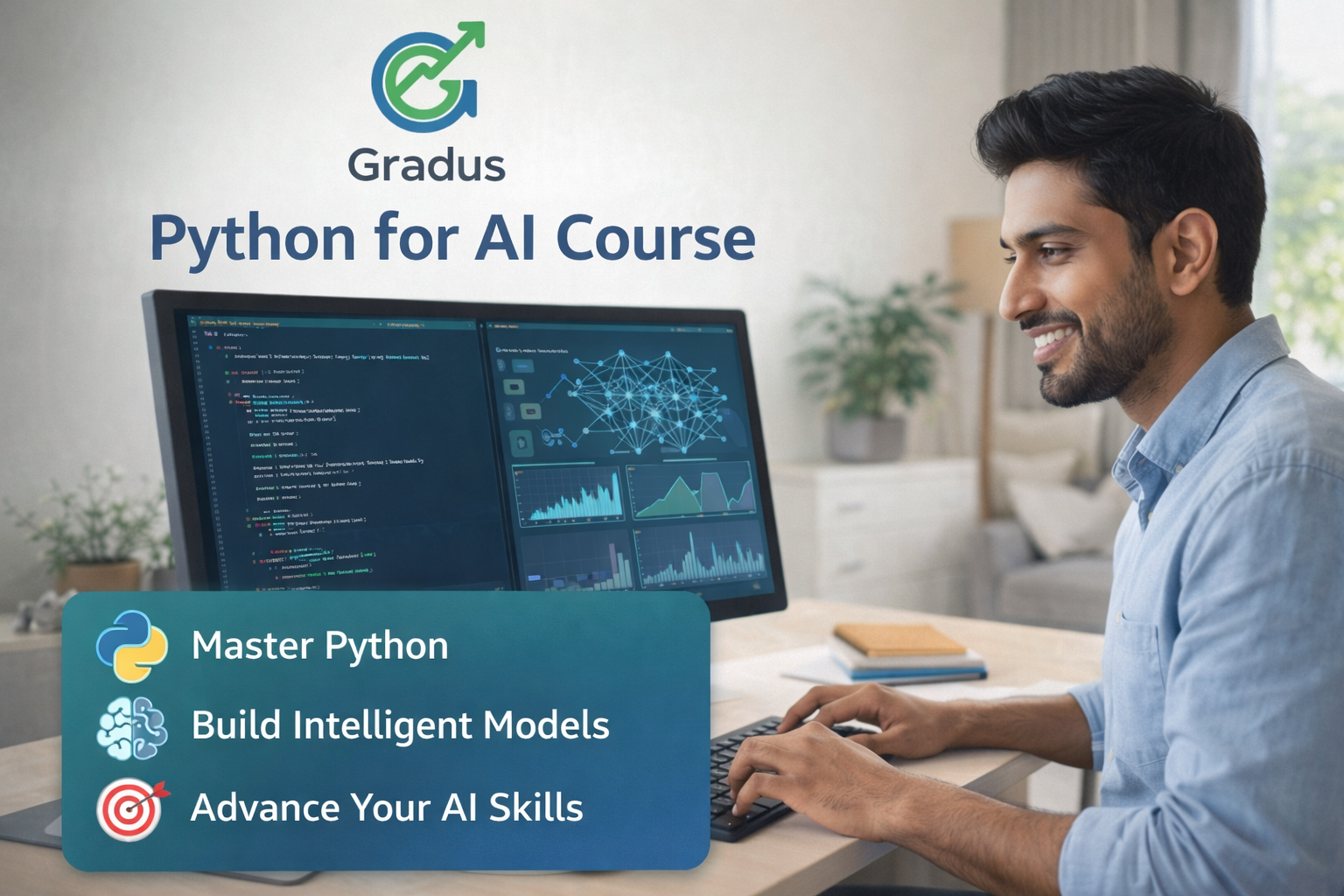
There are a million platforms out there, from the giants like Coursera to the niche “gurus” on YouTube. However, if you are looking for a program that is specifically tailored to the current Indian and global tech landscape—one that balances theory with the raw, practical skills needed for the 2026 job market—you should check out the Python for AI course offered by Gradus.
What makes this specific path stand out is the focus on “Humanized” learning. It’s designed for the person who might be intimidated by the “math-heavy” reputation of AI but has the drive to build real-world solutions.
Is a “Python for AI” Certification Actually Worth It?
Let’s address the elephant in the room. Does a piece of digital paper actually get you a job?
In 2026, the answer is: Yes, but only if it’s backed by a portfolio. A Python for AI certification acts as a signal to recruiters. It says, “I have the discipline to follow a structured curriculum, and I understand the ethical and technical guardrails of modern AI.” In a world where everyone is “prompting,” having a verified credential in the underlying engineering language sets you apart from the “AI hobbyists.”
| Feature | Python for AI Course | Generic Coding Bootcamp |
| Primary Focus | Data science & Neural Networks | Web development & UI/UX |
| Key Libraries | NumPy, PyTorch, LangChain | React, Node.js, HTML/CSS |
| Career Path | AI Engineer, Data Scientist | Web Developer, Frontend Dev |
| 2026 Demand | Critical (High Growth) | Stable (Saturated) |
The “Human” Struggle: Dealing with the Learning Curve
I want to be real with you for a second. Learning Python for AI can be frustrating. You will run into “Indentation Errors.” You will get confused by “Tensors.” You will wonder why your model is giving you nonsense answers.
This is the most important part of the process. Every senior AI engineer you see on LinkedIn has had those moments. The difference between a successful developer and someone who quits is the ability to sit with that frustration. A good Python for AI course online provides the community and mentorship to pull you out of those ruts.
Why 2026 is the “Golden Year” to Learn
We are currently in the “Goldilocks Zone” of AI. The tools have become stable enough to be useful, but the market isn’t yet fully saturated with experts. By taking a Python for artificial intelligence training now, you are positioning yourself as a “Senior” in this space by the time the rest of the world catches up in 2028.
Key Skills You’ll Walk Away With:
- API Integration: Learning how to make Python talk to OpenAI, Anthropic, and Google Gemini.
- Data Visualization: Making complex AI decisions understandable to human stakeholders.
- Model Fine-Tuning: Taking a “base” AI and making it an expert in a specific field (like law, medicine, or finance).
Final Thoughts: What is Your “Version 2.0”?
The transition from a “traditional” worker to an AI-augmented professional is the biggest upgrade you can give your career. Whether you are a marketer looking to automate content, a data analyst looking to predict the future, or a student wanting to be at the forefront of the next industrial revolution, Python is your entry ticket.
Don’t just watch the world change around you. Be the one who writes the code that changes it.
Frequently Asked Questions (The “Quick Hits”)
1. Do I need to be a math genius?
No. While understanding basic statistics helps, modern Python libraries handle the heavy calculus for you. You need logic more than you need advanced algebra.
2. How long does it take?
Most dedicated students can go from “zero” to “building basic AI projects” in about 8 to 12 weeks of consistent study.
3. Is Python better than Java for AI?
In 2026? Yes. The community support, libraries, and ease of use make Python the gold standard for AI research and production.